
Materializing Boundaries : background, an exercise, an artwork, and a book
Background:
This weekend, I almost walked out of a somatic workshop.
A group of ten strangers and I were instructed to use a piece of string to create a boundary to encircle our bodies on the floor. In my bodymind, I jumped to judgment (e.g., "this is cheesy and embarrassing") to fear (e.g., "I don't think I can do this without freezing or shutting down").
In the parlance of the doula, I leaned into the "uncomfortable yes" and proceeded to select the least obtrusive string I could find. While pulling out a skein, my partner from previous exercises announced they were looking for a partner. It's cool, they probably wanted a change. But I was suddenly embarrassed. I had to then meekly announce that I was also looking for a partner. A very kind person approached me and asked if I wanted to join their group of two.
I said, "yes, thank you." (Another "uncomfortable yes.")
More fear. My partners were now: one straight cis man and one gender spectrumy person who later identified themself as a cis man with caveats. These were the last two people I would have chosen in the gallery, not because of who they were but because of my own complex relationship to gender and cis men. I didn't feel that I could actually do this exercise with these warm people because of my own trauma.
And then, something resplendent happened: both people coached me through my boundary with more compassion, awareness, and curiosity than I've ever received in relation to my body in my life. I made a boundary that was much smaller than I wanted because I felt that I needed to accommodate them. I did not want them to touch the boundary or help me arrange the string. Intuitively, both partners felt this tension, and they stood farther back from the boundary than the yarn circle I had created on the floor.
They asked, "It seems like your boundary actually needs to be MUCH bigger than you made it?"
Apologetically, I replied, "It feels selfish to make it bigger."
And one of the partners compassionately echoed, "It feels selfish to actually have the amount of space that you NEED?"
"Yes," I teared up.
Together, they used their bundles of string to make a new boundary for me, with my instructions. It wasn't even the same shape; my new boundary was a satisfying, thick line of string across a small room that my partners made for me. I was finally, comfortably enveloped. Artwork and any more-than-human entities were allowed inside the boundary; humans were not, at least in that moment.
My partners asked me questions about my experience in the world (of overwhelm, of compression) and listened thoughtfully to the answers. Attentively, they asked follow-up questions. The more we talked, and I felt heard, the closer I moved towards them. At the end of the exercise, they asked me how I wanted to disassemble my boundary; I asked if we could do it together, while expressing deep gratitude for their presence and care. I wasn't scared of them anymore.
And it made me feel sad that it took so long to get here. It was so healing to have two men be kind to me, to ask me questions, to listen to the answers, to ask follow-up questions, to center my experience, and to truly care about how I felt. Which is why I'm sharing this exercise with you, in case you'd like to see what it might reveal.
Exercise:
Working with a trusted therapist or doula might be a good place to start if you are scared. Ask a friend, partner, therapist, doula, or stranger whom you can trust if they would like to do this exercise with you. Use a piece of string to draw a shape around yourself on the floor, establishing your boundary. Coach your partner: can they enter the boundary? Where in relation to the boundary should they stand? Your partner can ask you questions about your boundary. And they can refuse; everyone gets consent. Then switch places to repeat the exercise.
Artwork:
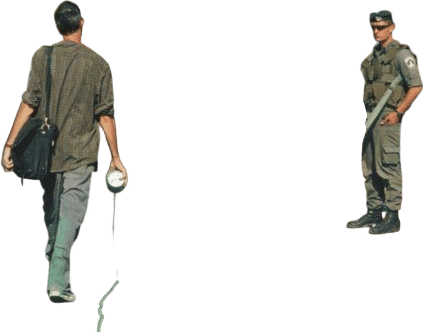
Francis Alÿs, "Green Line." (See link for more context; it's a more sociopolitical and poetic meditation on a boundary, but worth thinking about nonetheless.)
Book:
Set Boundaries, Find Peace by Nedra Glover Tawwab. (I read this when it was first released and gleaned a lot from Nedra's work. I think doing this physical exercise helped me to understand more about my relationship to boundaries spatially and in regard to my body. The way I was thinking about boundaries and Nedra's work was more linguistic before. It's likely time to revisit!)
2 months ago
Comments



Follow D
By submitting, you agree to our Terms and Privacy Policy